The Design and Practical Advantages of a French Fries Scoop Box
When considering the packaging for food items like french fries, the container itself plays a critical role beyond simple containment. The design known as a French Fries Scoop Box represents a specific approach to this challenge, merging functionality with presentation. This packaging template is engineered to handle the particular demands of serving hot, often greasy, snacks in a busy environment, whether it's a fast-food counter, a festival concession stand, or a casual restaurant.
Structural Integrity and Material Considerations
The physical construction of a scoop box for fries is not arbitrary. The template typically calls for a paper weight between 200 and 350 GSM. This range is selected to deliver a strong structural integrity, allowing the box to hold its shape without collapsing under the weight of the contents. It also enables clean, sharp folds during manufacturing, which is essential for a professional finish. Furthermore, paper within this specification often incorporates grease-resistant properties, a non-trivial feature when dealing with fried foods. This resistance helps prevent unsightly oil stains and maintains the box's rigidity during use, ensuring it doesn't become soggy and fail.
The Geometry of Service and Stability
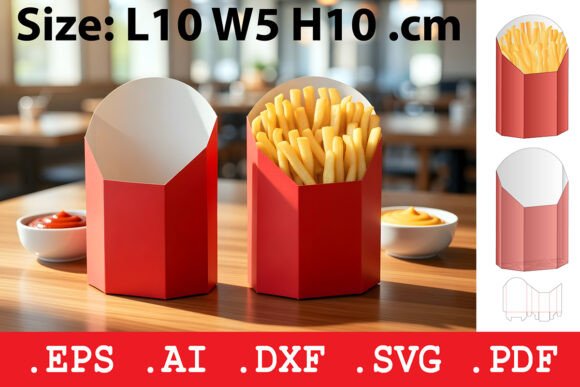
The shape of the French Fries Scoop Box is where its clever design truly shines. The tapered scoop form with a wide open top is deliberately designed for easy filling by staff and effortless access for the consumer. This open presentation allows the fries to be seen, which is psychologically appealing, suggesting freshness and abundance. The angled sides are not merely aesthetic; they guide the fries towards the eater and create a visually attractive, pyramidal presentation that stands out amongst flat-bottomed containers.
Perhaps a less obvious but vital feature is the hexagonal base. A circular base might seem intuitive, but a hexagon provides superior stable standing. This multi-point contact with a surface prevents rocking and makes the container less prone to tipping, a common annoyance with less stable packaging. This stability is crucial in high-movement environments like a crowded sports event where a patron might be balancing several items.
Broad Application Across Users and Scenarios
The utility of this packaging design extends to a surprisingly diverse audience. For business owners and professionals in fast-casual dining or concession operations, it offers a reliable, brandable solution that enhances the customer experience. Creators and hobbyists, especially those involved in custom food ventures at local markets or pop-up events, find value in its DIY-friendly nature. Educators and researchers in packaging design or food service logistics might study it as an example of practical problem-solving. Even consumers indirectly appreciate its benefits through a more enjoyable and mess-free eating experience.
Real-world use cases are numerous. Beyond the classic fast-food fry serving, this box template is excellent for other snack items like roasted potato wedges, vegetable sticks, or even sweet items like churros or cookie pieces at a bakery. Its design makes it suitable for any grab-and-go scenario where presentation and portability are key. Events ranging from school fundraisers to large corporate gatherings often utilize such containers for their food stations due to the combination of efficiency and visual appeal.
The Ecosystem of Customization and Production
For those looking to implement or customize this design, the included file formats create a complete ecosystem for production. The .DXF file compatibility with CNC and laser cutting hardware allows for precise, automated manufacturing on industrial scales. The .SVG and .EPS vector formats enable graphic designers to seamlessly integrate branding, logos, and decorative elements into the template using digital design software or craft cutters. The .PDF serves as a universal print-ready document for smaller operations that might use manual cutting or simply require a reliable viewing format. Access to the original .AI Adobe Illustrator source file provides the deepest level of customization, allowing alterations to dimensions, graphics, or even minor structural tweaks to suit a very specific need.
This multi-format approach means the French Fries Scoop Box template is accessible to a maker with a desktop laser cutter, a large-scale packaging contractor with industrial machinery, and a graphic artist working on brand identity. It democratizes the use of a professionally designed container.
Operational Benefits in a Service Workflow
From an operational perspective, the design of the scoop box integrates smoothly into a service workflow. Its wide opening allows for quick, one-handed filling by kitchen staff, speeding up service during peak times. The stable base means it can be set down securely on a counter before being handed to a customer. For the consumer, the angled sides and open top make it easy to reach fries without digging or crushing them, and the structure often allows for condiment cups to be nestled safely within or beside the box.
Compared to standard flat bags or simple rectangular boxes, this template offers distinct advantages. Bags can obscure the product, lack structural stability, and often lead to fries being crushed at the bottom. Rectangular boxes with narrow openings can make access difficult. The French Fries Scoop Box addresses these shortcomings directly. It is a comparison that highlights how tailored design solves specific user experience problems.
Long-Term Trends and Environmental Considerations
Observing broader trends, even such a specific item reflects shifts in consumer expectations and industry practices. The emphasis on attractive presentation speaks to the modern diner's experience-driven mindset. The use of optimized, grease-resistant paper aligns with a move away from certain plastics while maintaining functionality. While not inherently a sustainability solution, a well-designed paper container that uses no excess material and is potentially recyclable in many systems is a step in a more considered direction compared to some alternatives.
Implementation of this box design requires considerations beyond just printing. One must think about the sourcing of appropriate paper stock, the logistics of storage for pre-folded boxes, and the integration of branding in a way that doesn't compromise the structural folds. The choice to use such a container is a balance between cost, customer perception, and operational efficiency.
In summary, the French Fries Scoop Box is more than a vessel; it is a considered application of design principles to a common service challenge. Its characteristics—the tapered scoop shape, wide top, hexagonal base, and specified material requirements—all converge to create a package that is stable, presentable, and functional. Its advantages are clear in faster service, reduced mess, and a superior customer presentation. For a wide range of users from business professionals to creative hobbyists, the availability of the design in multiple production-ready file formats makes it a practical and adaptable tool for enhancing how snacks are served and enjoyed.